Porsche Mission X: How Weissach Built the 1,500 HP Downforce Monster to Rule the 'Ring
E
Elena Rostova
· 9 min read read
0 min left
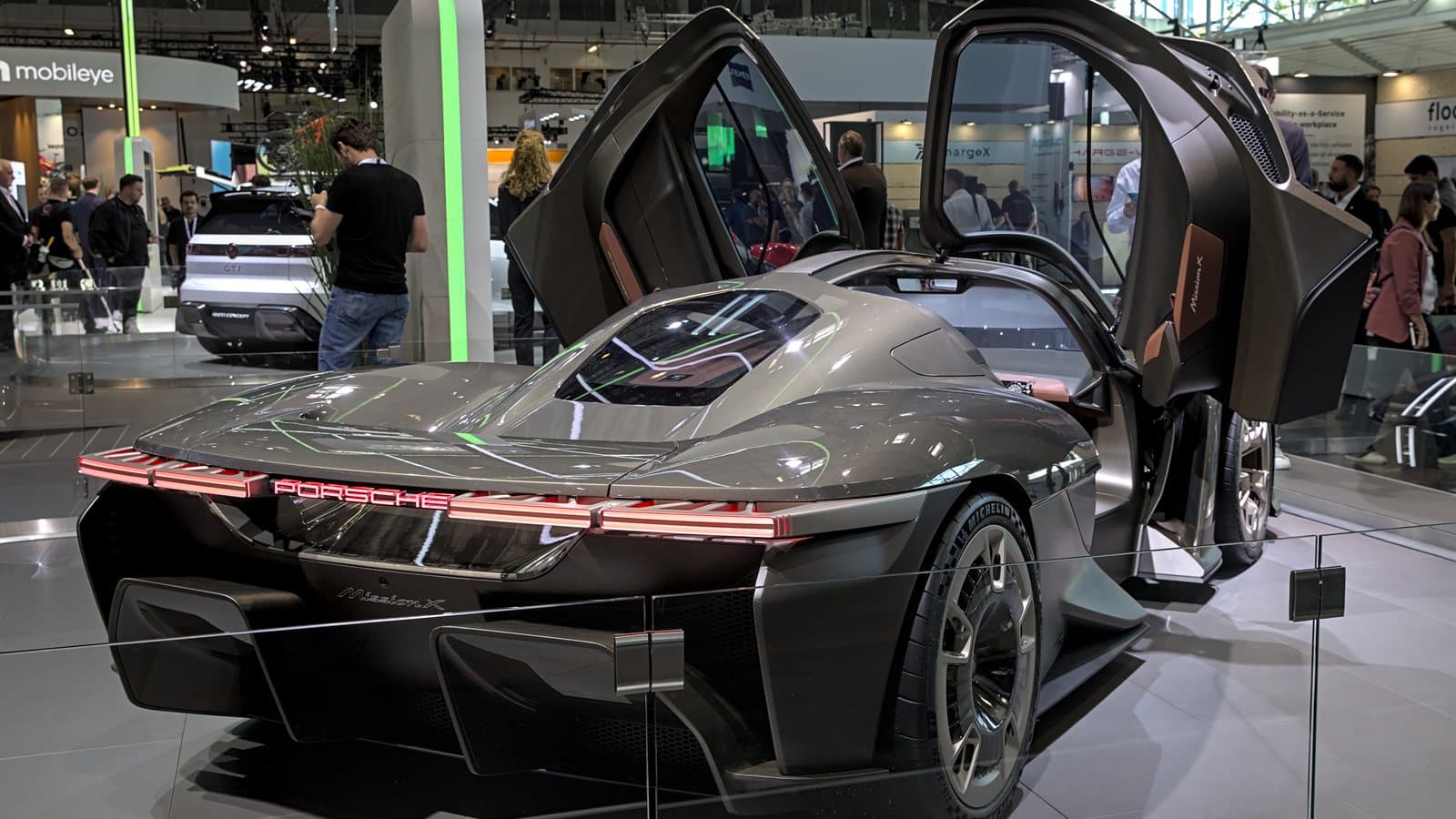
Porsche has produced only three halo hypercars in its modern history: the 959 in 1986, the Carrera GT in 2004, and the 918 Spyder in 2013. Each redefined the parameters of technological capability for its era. Now, Porsche Motorsport and Style Porsche in Weissach have unveiled their fourth beacon: the Porsche Mission X.
Standing beside the Mission X, its compact proportions evoke legendary Le Mans prototypes like the 906 and 917. At approximately 4.5 meters in length, 2.0 meters wide, and under 1.2 meters tall, it occupies the exact footprint of the Carrera GT, yet generates performance metrics that belong in Formula 1.
Porsche Mission X Concept Hypercar at IAA Mobility📷 Picture courtesy of Porsche AG
The Weissach Criteria: Four Non-Negotiable Pillars#
Porsche Chairman Oliver Blume established four strict engineering benchmarks for the Mission X production feasibility study:
1. Fastest Road-Legal Vehicle Around the Nürburgring Nordschleife: Must beat the current production record held by the Mercedes-AMG ONE (6:29.090).
2. 1:1 Power-to-Weight Ratio: Roughly one metric horsepower per kilogram of vehicle weight (~1,520 hp for 1,520 kg curb weight).
3. Downforce Figures Exceeding 911 GT3 RS: More than 860 kg of aerodynamic load at speed, achieved primarily through underbody ground-effect venturis.
4. Significantly Improved Charging Performance: A 900-volt system architecture capable of replenishing battery charge roughly twice as quickly as the Taycan Turbo S.
“"The Mission X is a technological beacon for the sports car of the future. It picks up the torch of iconic sports cars of decades past: like the 959, Carrera GT, and 918 Spyder before it, the Mission X provides decisive impetus for the evolutionary development of future vehicle concepts."”
Traditional electric vehicles package heavy battery skateboards across the entire floor, forcing drivers to sit relatively upright. For the Mission X, Porsche engineers developed the 'e-core' architecture—clustering the battery pack directly behind the two seats in place of where a mid-mounted combustion engine would normally sit.
This concentrates the polar moment of inertia directly in the center of the chassis, giving the car the authentic pivot response and nimble yaw fidelity of a mid-engine Porsche Carrera GT. The two carbon-composite bucket seats are integrated directly into the monocoque, with adjustable pedal boxes and steering columns moving to meet the driver.
System Voltage: 900V bi-directional fast charging
Peak Charging Rate: 450 kW DC (10% to 80% state of charge in ~12 minutes)
Aerodynamic Concept: Carbon exoskeleton with lightweight glass dome canopy and Le Mans-style upward-forward opening doors
Tires: Staggered 20-inch front wheels (265/35 ZR20) and 21-inch rear wheels (325/30 ZR21) with aerodynamic transparent carbon aero-blades
While competitors chase straight-line four-digit drag races, Porsche has focused on cornering agility, sustained circuit thermal stamina, and aerodynamic downforce. The Mission X is not an electric experiment; it is the definitive blueprint for the next 75 years of Porsche motorsport dominance.