When Porsche's GT division boss Andreas Preuninger set out to develop the 992-generation 911 GT3 RS, he did not merely aim to build a faster sports car. He sought to construct a road-legal Rennsport projectile that weaponizes airflow in ways previously reserved for Le Mans prototypes and Formula 1 machinery.
Arriving at Silverstone's Grand Prix circuit on a crisp morning, the visual presence of the GT3 RS stops you dead in your tracks. Every square centimeter of the bodywork serves a singular, ruthless purpose: channeling atmosphere into grip.
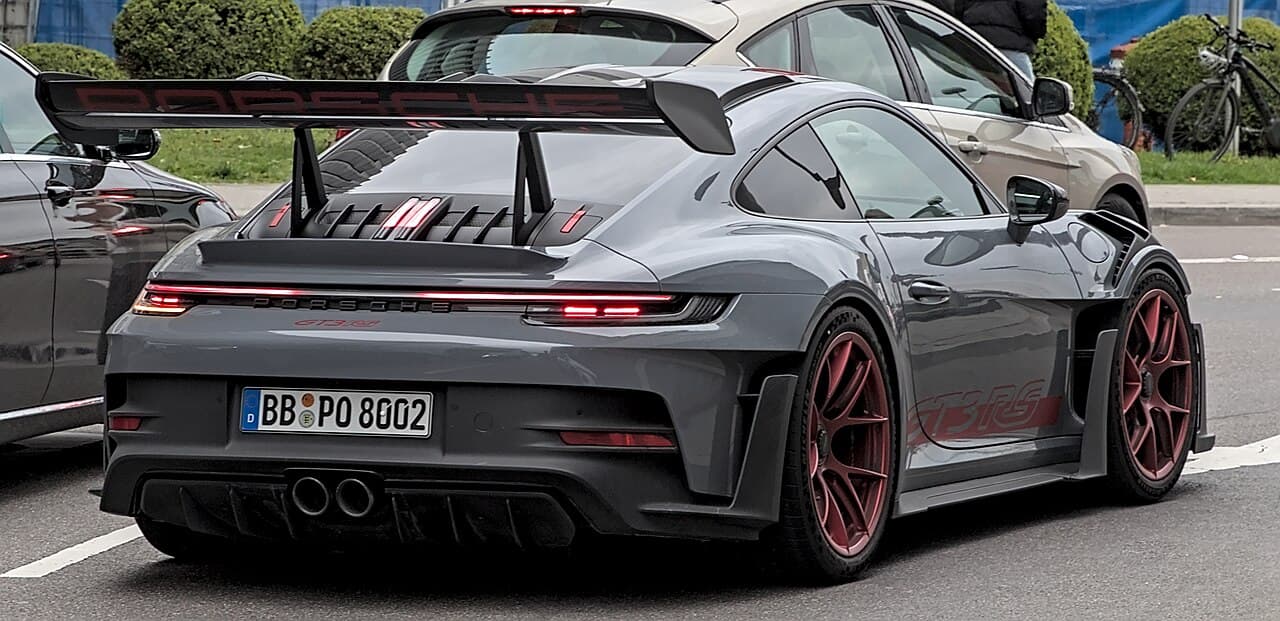
2025 Porsche 911 GT3 RS Swan-Neck Active Wing📷 Picture courtesy of Porsche Motorsport
The Aerodynamic Masterclass: 860 Kilograms of Atmosphere#
The foundational breakthrough of the 992 GT3 RS is its revolutionary cooling architecture. Instead of the three-radiator layout of previous generations, Preuninger's team eradicated the front luggage trunk entirely. In its place sits a single, massive, angled center radiator derived directly from the Le Mans-winning 911 RSR.
Freeing up space at the sides allowed engineers to integrate active aerodynamic elements directly into the front underbody. Continuously adjustable wing elements in the front apron work in millisecond concert with the colossal two-tier swan-neck rear wing.
Peak Downforce: 860 kg at 285 km/h (over 1,895 lbs of vertical thrust)
High-Speed Downforce: 409 kg at 200 km/h (more than double the 991.2 GT3 RS)
Active Drag Reduction System (DRS): Flattening rear wing flap and front diffusers via steering wheel button
Airbrake Functionality: Wings pivot upright under maximum braking from high velocity to dramatically shorten stopping distances
“"The GT3 RS does not merely grip the track; the atmosphere itself presses the chassis into the bitumen with such authority that your braking points must be mentally rewritten."”
Braking from 250 km/h into Stowe corner, the DRS immediately snaps shut, and the rear wing tilts forward to act as a parachute airbrake. The deceleration is so violent that your eyeballs strain against your visor, yet the chassis remains completely settled, devoid of the rear-end wiggle typical of rear-engine machines.
Climbing past the lightweight carbon-weave bucket seats and the bolted-in roll cage, your hands wrap around an Alcantara-wrapped steering wheel fitted with four distinct rotary selector dials. This is where the GT3 RS separates itself from every competitor on the market:
PASM (Porsche Active Suspension Management): Separate 8-stage rotary adjustments for both compression and rebound damping on the front and rear axles independently.
PTV Plus (Porsche Torque Vectoring Plus): Independent electronic calibration of coast-lock and power-lock rear differential settings.
Drive Mode Selector: Instant toggle between Normal, Sport, and bespoke Track configurations.
Dialing down rear rebound while softening front compression allows the Michelin Pilot Sport Cup 2 R rubber (275/35 R20 front, 335/30 R21 rear) to absorb the aggressive curbs of Becketts with surreal composure. You can physically tailor the vehicle's yaw response mid-lap as track temperatures change.
Porsche 911 S/T Lightweight Heritage Sibling📷 Picture courtesy of Porsche AG
The 4.0-Liter Boxer: 9,000 RPM of Naturally Aspirated Fury#
Behind the rear axle lies Porsche's mechanical crown jewel: the 4.0-liter naturally aspirated flat-six. Modified with new camshafts featuring modified lobe profiles and a rigid valve drive derived from the GT3 Cup racer, it produces 525 PS (518 hp) and 465 Nm of torque.
Engine Configuration: 4.0-liter naturally aspirated boxer-6 with individual throttle bodies
Rev Limit: 9,000 RPM redline
Transmission: 7-speed dual-clutch PDK with shortened final drive ratio
0–100 km/h (0–62 mph): 3.2 seconds
Top Speed: 296 km/h (184 mph)
Curb Weight: 1,450 kg (DIN) with Weissach Package magnesium wheels
Holding third gear through the sweeping Maggotts and Becketts complex, the exhaust note climbs from a gravelly baritone into a metallic, spine-tingling acoustic wail as the digital tachometer blinks yellow at 9,000 rpm. The short-ratio 7-speed PDK cracks off gear shifts with instantaneous rifle-shot precision.
In an automotive universe increasingly reliant on forced induction, heavy hybrid batteries, and artificial synthetic sound generators, the 2025 Porsche 911 GT3 RS stands as an uncompromising monument to mechanical honesty and motorsport physics. It does not coddle or compromise; it rewards skill, demands focus, and sets the definitive benchmark for road-legal track performance.